

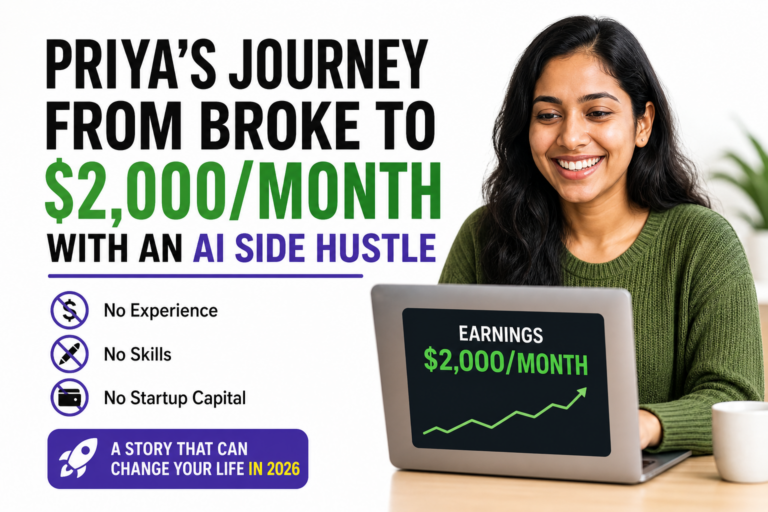
It was 11:47 PM on a Tuesday when Priya finally closed her laptop and stared at the ceiling.
The spreadsheet was still open in her mind — rent, groceries, EMI, electricity, phone bill — all of it stacked up against a salary that hadn’t moved in two years. She wasn’t struggling in the dramatic, cinematic way people talk about on the internet. She was struggling in the quiet, exhausting way that most people never talk about. The kind where you’re technically fine but one unexpected expense away from not being fine at all.
She was 28 years old, working a decent marketing coordinator job at a mid-sized logistics company, and for the past six months she had been Googling the same thing at night: “how to make extra money online.”
The results were always the same. Drop-shipping. Print on demand. Crypto. Real estate. She’d clicked through a hundred tabs and come away with the same feeling every time: these weren’t for her. They required capital she didn’t have, skills she hadn’t built, or time she simply couldn’t spare.
She typed one more search before bed, almost out of habit.
“AI side hustle 2026 no experience.”
And this time, something was different.
The Rabbit Hole
The article she landed on was simple. No flashy promises. No screenshots of fake earnings. Just a clear, structured breakdown of how ordinary people — teachers, call center workers, stay-at-home parents — were using AI tools to offer services online and getting paid for it.
Priya sat up straighter.
She read about a woman in Pune who was writing blog posts for small businesses using Claude and ChatGPT, earning ₹30,000 a month on the side. She read about a 22-year-old in Manila creating AI-generated social media graphics for e-commerce brands on Fiverr. She read about a retired school teacher in Ohio who was setting up simple AI chatbots for local restaurants and charging $200 a pop.
These aren’t tech people, she thought. These are just people who started.
She didn’t sleep until 1:30 AM. But for the first time in months, it wasn’t worry keeping her awake.
It was possibility.
Step One: Choosing Her Lane
The next morning, Priya opened a fresh Notion page and wrote one question at the top: What can I actually do?
She’d spent years in marketing, which meant she understood content, she understood what businesses needed, and she could write reasonably well. Not brilliantly — she was the first to admit that. But competently. Clearly. And more importantly, she understood what made content work — the hooks, the calls to action, the way a headline had to earn the click.
That was the insight she’d been sitting on without realizing it.
She didn’t need to be a great writer. She needed to help AI write greatly — and then know how to recognize when it had.
She Googled “AI content writing Fiverr” and found hundreds of gigs. Some were charging $5. Some were charging $200. The difference, she noticed quickly, wasn’t skill. It was positioning. The $200 sellers didn’t just offer “blog posts.” They offered “SEO-optimized blog posts for SaaS companies” or “email sequences for e-commerce fashion brands.” They had picked a lane, gone deep, and the market rewarded them for it.
Priya decided her lane would be AI-written content for small business owners — website copy, blog posts, and email newsletters. Businesses she understood. Content she felt confident editing and improving.
She wrote it down. She didn’t tell anyone yet. It felt too new, too fragile to speak out loud. But she wrote it down.
Step Two: Learning the Tools (For Free)
She gave herself one weekend.
Not to master everything — she knew that trap. Analysis paralysis had killed her last three “I’m going to start something” moments. So she made a rule: two days, three tools, one test project. That’s it.
Day one was Claude and ChatGPT. She spent Saturday morning writing prompts, reading the outputs, rewriting the prompts, comparing results. She was genuinely stunned at how good the writing was when she gave it enough context. The first time she typed a vague prompt — “write a blog post about coffee” — she got something generic and forgettable. The moment she typed something specific — “write a 900-word blog post about the health benefits of black coffee for busy professionals in their 30s, tone: warm and science-backed, include 5 subheadings and a CTA to download a free guide” — the output was something she would have been proud to submit herself.
So that’s the skill, she thought. Knowing how to ask.
Day two was Canva AI and a quick dive into SEO basics — just enough to understand keywords and structure. She made three sample pieces: a fake blog post for a fictional bakery, a homepage rewrite for a fictional yoga studio, and an email newsletter for a fictional skincare brand. She used AI for the heavy lifting and spent her time editing, refining, making it feel human.
By Sunday evening, she had a three-piece portfolio. It had taken her maybe nine hours total.
She posted it in a Google Drive folder, made a basic Notion page that looked vaguely like a website, and wrote her first Fiverr gig description.
Her hands were shaking slightly as she clicked publish.
Step Three: The First Order
Two weeks passed. Nothing.
She refreshed the Fiverr dashboard every morning. She tweaked her gig title. She read forums about Fiverr SEO. She lowered her price from $25 to $15 for the starter package. She uploaded a new thumbnail she’d designed in Canva at midnight.
Then, on a Wednesday evening, the notification came.
You have a new order.
She stared at her phone for a full thirty seconds before the reality landed. Someone — a stranger somewhere in the world — had seen her gig, looked at her samples, and decided she was worth $15.
The client was a small yoga studio owner in the UK who needed a 700-word blog post on “the benefits of morning yoga for working moms.” She had 48 hours.
She opened Claude, wrote a detailed prompt, got a strong draft, edited it for 45 minutes, added a personal opening paragraph in her own voice to set the tone, and delivered it with a polite, professional message. She included a note saying she’d be happy to revise anything — just let her know.
The client replied in four hours.
“This is lovely! Exactly what I needed. No revisions. Five stars from me.”
Priya read the message three times. Then she walked to her kitchen, made herself a cup of tea, and sat at the table in silence. It sounds small — $15, a short blog post, a stranger in the UK who was probably already scrolling past it. But it wasn’t small. It was proof. It was the first real piece of evidence that this was not just a thing people on the internet did. It was a thing she could do.
She went back to her laptop and wrote three more client proposals that night.
Step Four: Finding a Rhythm
By the end of month two, Priya had completed 14 orders. Her average rating was 4.9 stars. She had raised her starter price to $25 and added a premium package at $75 for a full content bundle — blog post, social media caption set, and email newsletter.
She was making roughly $600 a month on top of her salary.
It didn’t happen without friction. There was the client who kept changing the brief after delivery and needed three revisions before they were happy. There was the order she almost missed because she underestimated how long editing would take. There was the week she felt burned out and questioned whether this was sustainable.
But she kept going, and she kept learning.
She started keeping notes on what worked — which prompts got the best first drafts, which types of clients communicated most clearly, which niches paid the most with the least back-and-forth. She refined her process until she could deliver a strong 900-word blog post, fully edited and formatted, in under 90 minutes.
That was the breakthrough moment she hadn’t expected. She’d assumed AI would make the work easier. She hadn’t anticipated how fast she’d get at directing it.
She began offering free 10-minute consultations for potential clients — just a short call to understand their brand voice before she wrote anything. Three of those consultations turned into monthly retainer clients who each paid her $200/month for a content package.
Her monthly earnings crossed $1,200. Then $1,600.
By month five, they were touching $2,000.
Step Five: What “Scaling” Actually Looks Like
Priya’s life didn’t transform overnight. That’s not how this story goes. She still woke up, made her coffee, opened her laptop at the same kitchen table. She still had the same job, the same apartment, the same friends.
But the feeling had changed entirely.
The rent was no longer a source of dread. She’d built a small emergency fund for the first time in her adult life. She was saving a little — not a lot, but something. And more than the money, she had something she didn’t know she was missing: evidence that her judgment had value, that she could build something, that she was not stuck.
She started thinking bigger. She hired a part-time virtual assistant — another freelancer she found on Upwork — to handle basic client communication and formatting, which freed up three hours a week for more writing and more proposals. She created a Gumroad product: a pack of 50 AI writing prompts for small business owners, priced at $9. It made $300 in its first month without her doing anything after upload.
She raised her rates again. $100 for a blog post. $350 for a content bundle. She dropped the clients who weren’t a good fit and focused on the ones who valued her work.
By month eight, she was making more from her side hustle than from her salary.
She hasn’t quit her job yet. She’s being deliberate about it. But for the first time, she has a choice. And having a choice changes everything.
What Priya Learned That She Wants You to Know
When I asked Priya what she’d tell someone sitting where she was twelve months ago — staring at the ceiling, Googling the same things, feeling like the opportunity was always meant for someone else — she didn’t hesitate.
“The tools are free. The learning curve is a weekend. The only thing standing between you and the first order is the moment you stop preparing and start doing.”
She said the biggest lie she told herself for the longest time was that she needed to be ready. That she needed a course, a certification, a better portfolio, a more polished gig page. Every week there was a new reason to wait.
What she knows now is that none of it — not the five-star rating, not the retainer clients, not the $2,000 months — would have happened if she’d waited until she felt ready.
She started imperfect. She delivered imperfect work. She got imperfect feedback. And she got incrementally better with every single order, in a way no amount of preparation could have given her.
Your Story Starts Now
Priya’s story isn’t special. That’s the whole point.
She didn’t have a tech background, a business degree, or a large following. She had a laptop, a free Claude account, a Fiverr profile, and a quiet Tuesday night where she finally decided to do something different.
In 2026, the tools have never been more powerful. The demand has never been higher. And the path has never been more clearly laid out for someone exactly like you.
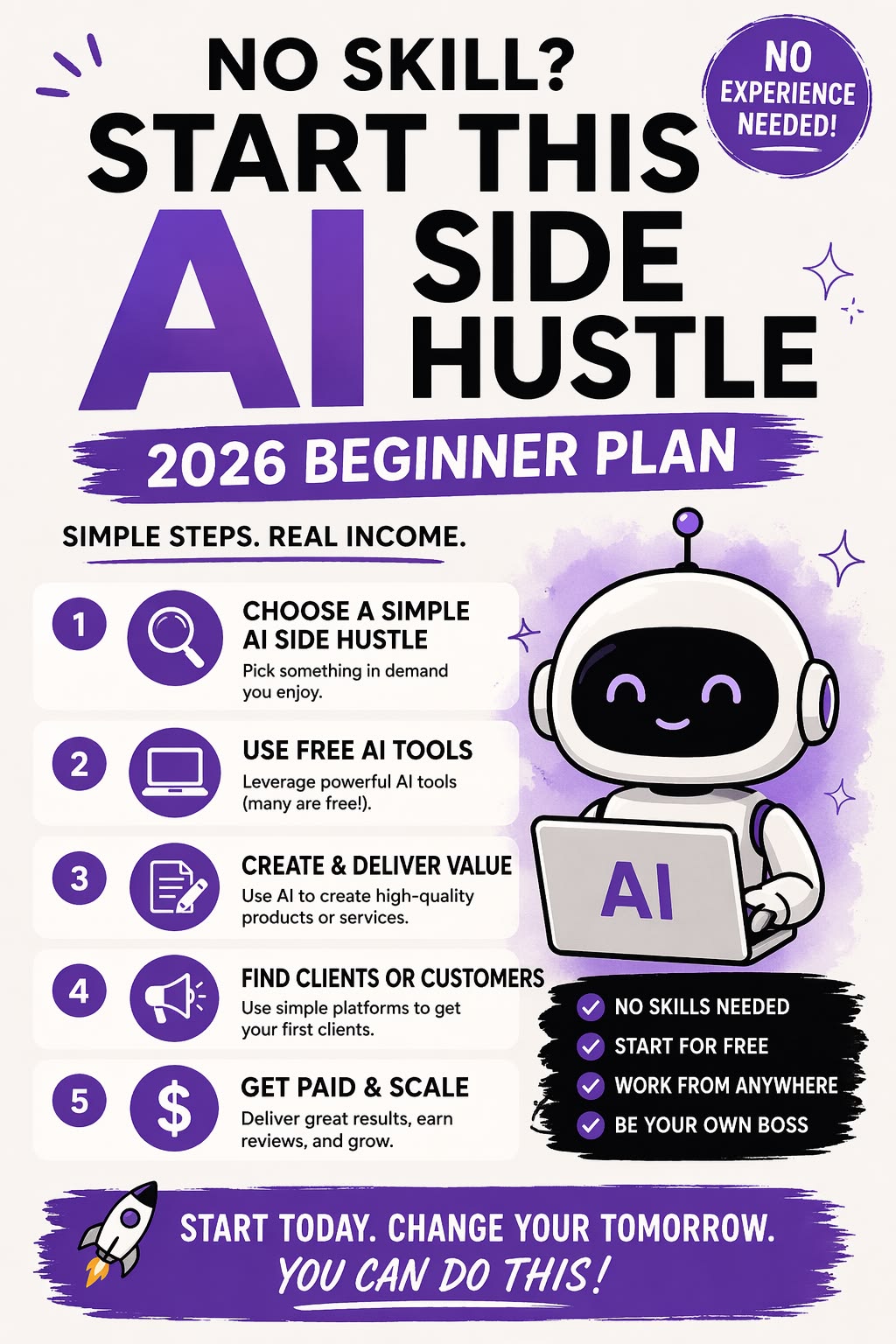
All five steps are available to you right now:
- Choose a simple AI side hustle that matches something you already know or care about
- Use free AI tools — Claude, ChatGPT, Canva AI, and dozens more — to do the heavy lifting
- Create and deliver value that clients actually need and will pay for
- Find your first clients on Fiverr, Upwork, LinkedIn, or through people you already know
- Get paid, refine, and scale — one review, one repeat client, one rate increase at a time
The first $15 you earn online will feel bigger than any paycheck you’ve ever received. Not because of the amount — but because of what it proves.
It proves that you can.
So close the tab you have open right now comparing side hustles. Open a new one. Start your Fiverr account. Write your first prompt. Make your first sample.
Start today. Change your tomorrow.
You can do this.

0 Comments